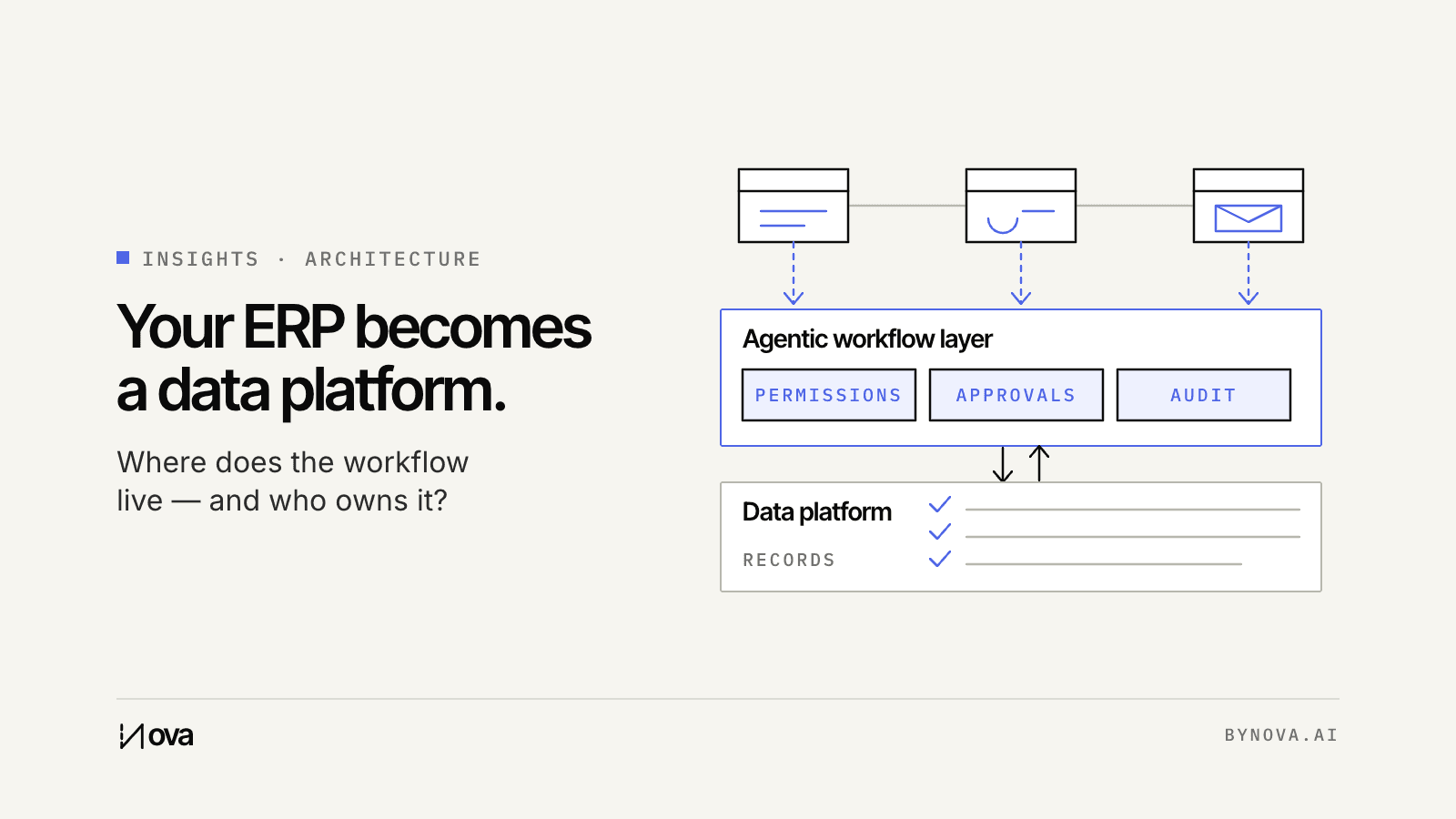
Enterprise software used to do two jobs in one product: hold the records and enforce the process. Agents pull those jobs apart. The records stay where they are. The process moves up into a layer that spans systems — and that layer, not the database underneath it, is where your company's advantage ends up living.
So the architecture question is no longer "which suite do we standardise on?" It is: where does the workflow live, and who owns it?
An agentic workflow layer is the software above your systems of record that carries a process end to end: it reads the request, gathers what it needs from the connected systems, applies your rules, stops at the approval points you defined, and leaves an audit trail of what it did.
The records stay; the process moves
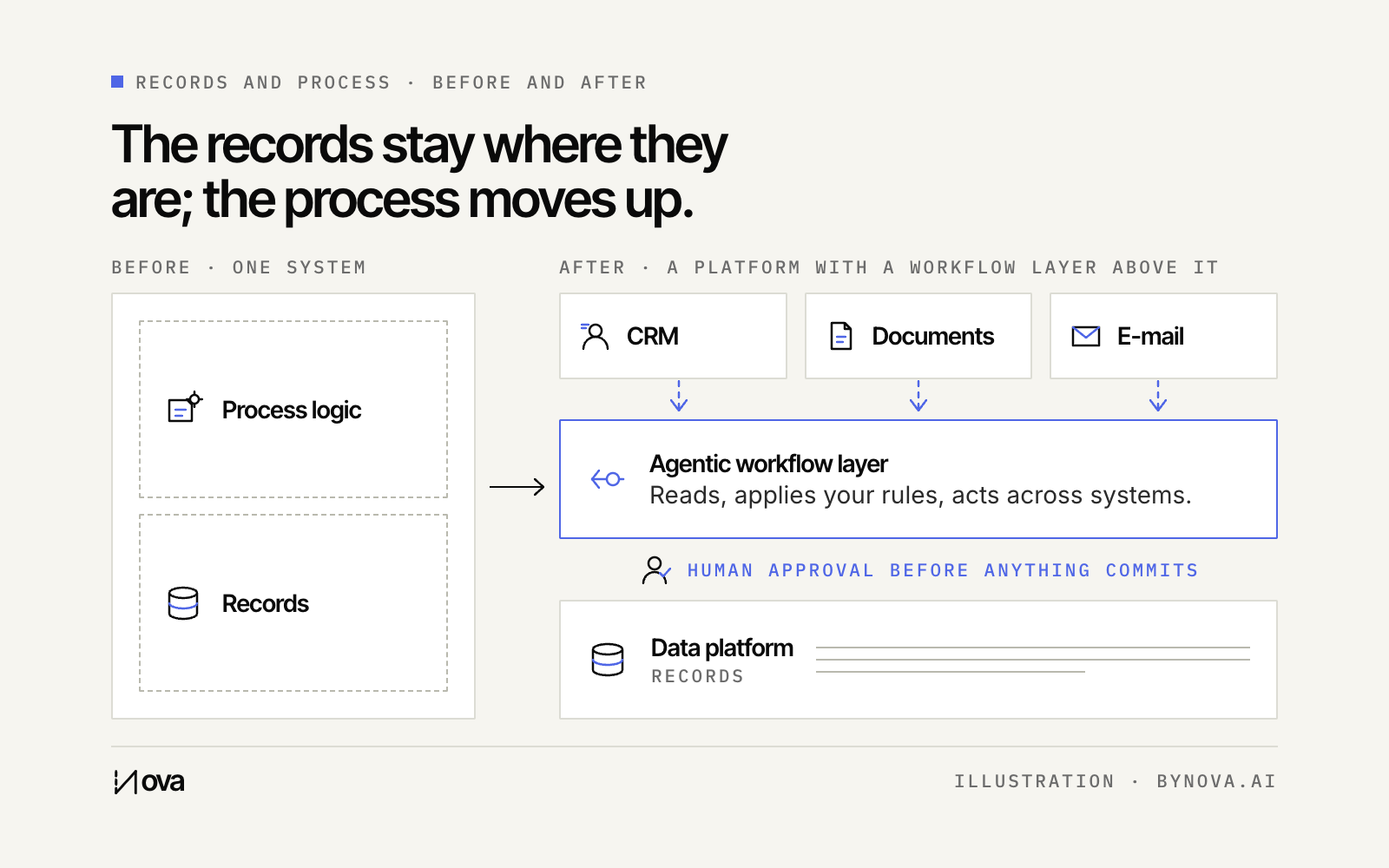
In most companies a process is a sequence of human hand-offs between screens: read the mail, look up the customer, check stock, apply the discount rule, draft the document, ask a colleague, update the record. Each step is small. The sequence is the job.
An agent can carry that sequence, which means the process no longer needs to be implemented inside the application that stores the record. What it does need is somewhere to run with proper identity, permissions, orchestration, approval steps and an audit trail. That is a product in its own right, and for most companies it is the first piece of genuinely strategic software they will own in years.
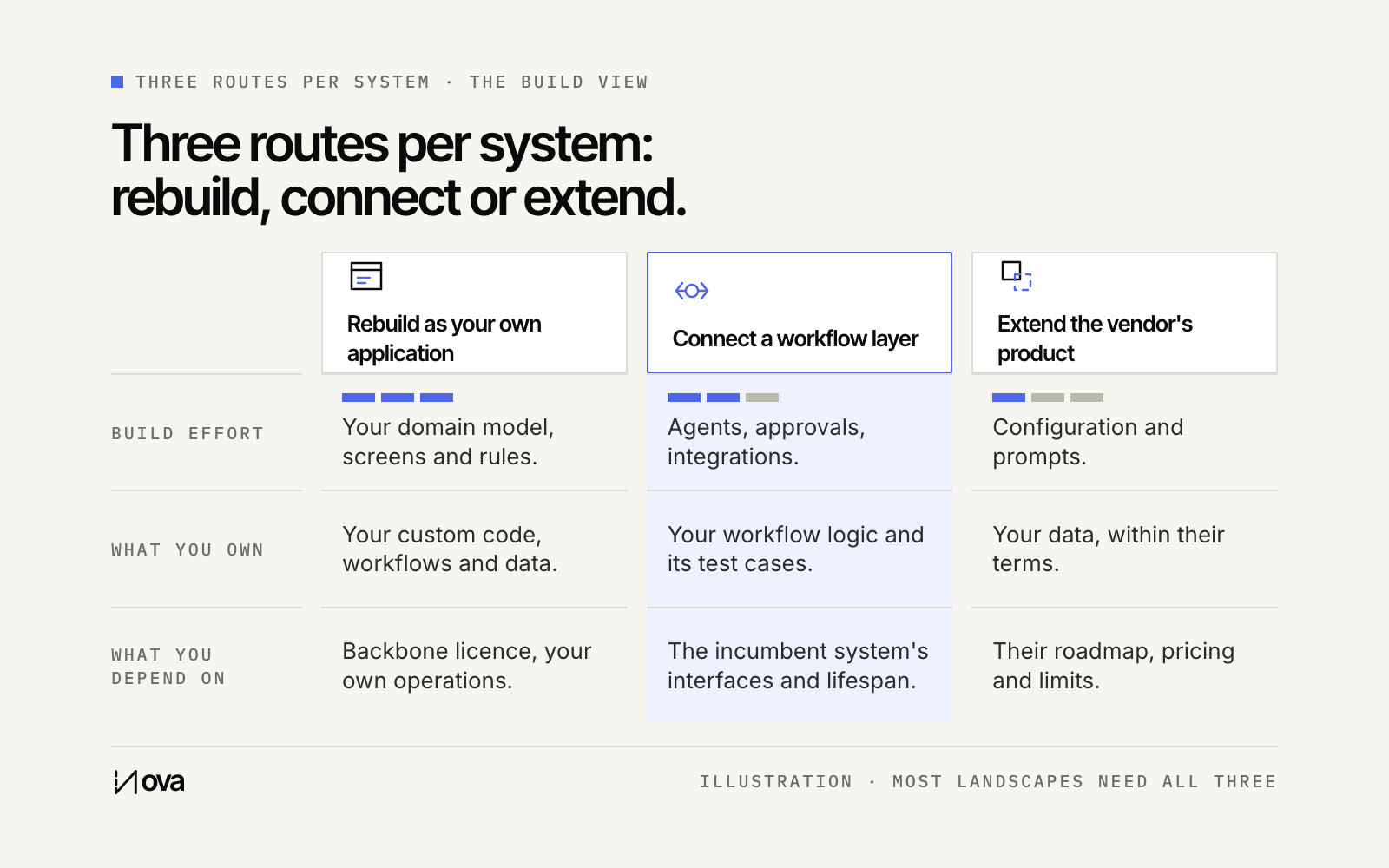
Three routes per system — from the builder's side
The decision repeats per system. ScopeRight frames it as replace, connect or stay from an advisory standpoint. Here is what each route means once you are actually building.
Rebuild it as your own application
Worth it when the system is effectively a store of records with a user interface, and the process around it is yours. On a shared backbone the undifferentiated work — access, permissions, workflow orchestration, audit, administration, APIs — is already there, so the build is your domain model, your screens and your rules.
The honest warning belongs here too: a records application and a full ERP are different orders of magnitude. We will say so when a scope sits on the wrong side of that line.
Connect a workflow layer to it
The common case. The system keeps the records and its own strong processes; your layer runs the work that crosses systems. Two things decide whether this ages well: the quality of the interfaces you depend on, and the discipline to settle the replacement question first. Every integration you build raises the cost of leaving the system you integrated with.
Extend what the vendor ships
Sometimes the vendor's own AI capability is good enough for the workflow in question, and building anything would be waste. Judge it on what is in production for customers like you. Then accept the trade-off: the logic lives in their product, and your improvement rate follows their roadmap.
| Route | What you build | What you own | What you depend on |
|---|---|---|---|
| Rebuild as your own application | Domain model, screens, rules, on a licensed backbone | Your custom code, workflows and data | Backbone licence, your own operations |
| Connect a workflow layer | Agents, orchestration, approvals, integrations | Your workflow logic and its test cases | The incumbent system's interfaces and lifespan |
| Extend the vendor's product | Configuration and prompts inside their platform | Your data, within their terms | Their roadmap, pricing and limits |
What belongs in the layer you own
This is the part that gets underestimated, because it does not look like software. In an agentic product, these are the assets:
- the instructions and context given to each agent;
- the decision rules — pricing, compatibility, eligibility, escalation;
- the approval conditions: which actions need a human, and whose name is on them;
- the integration contracts: what is read, what is written, with which permissions;
- the regression set: the real cases that prove the behaviour is still correct after a change.
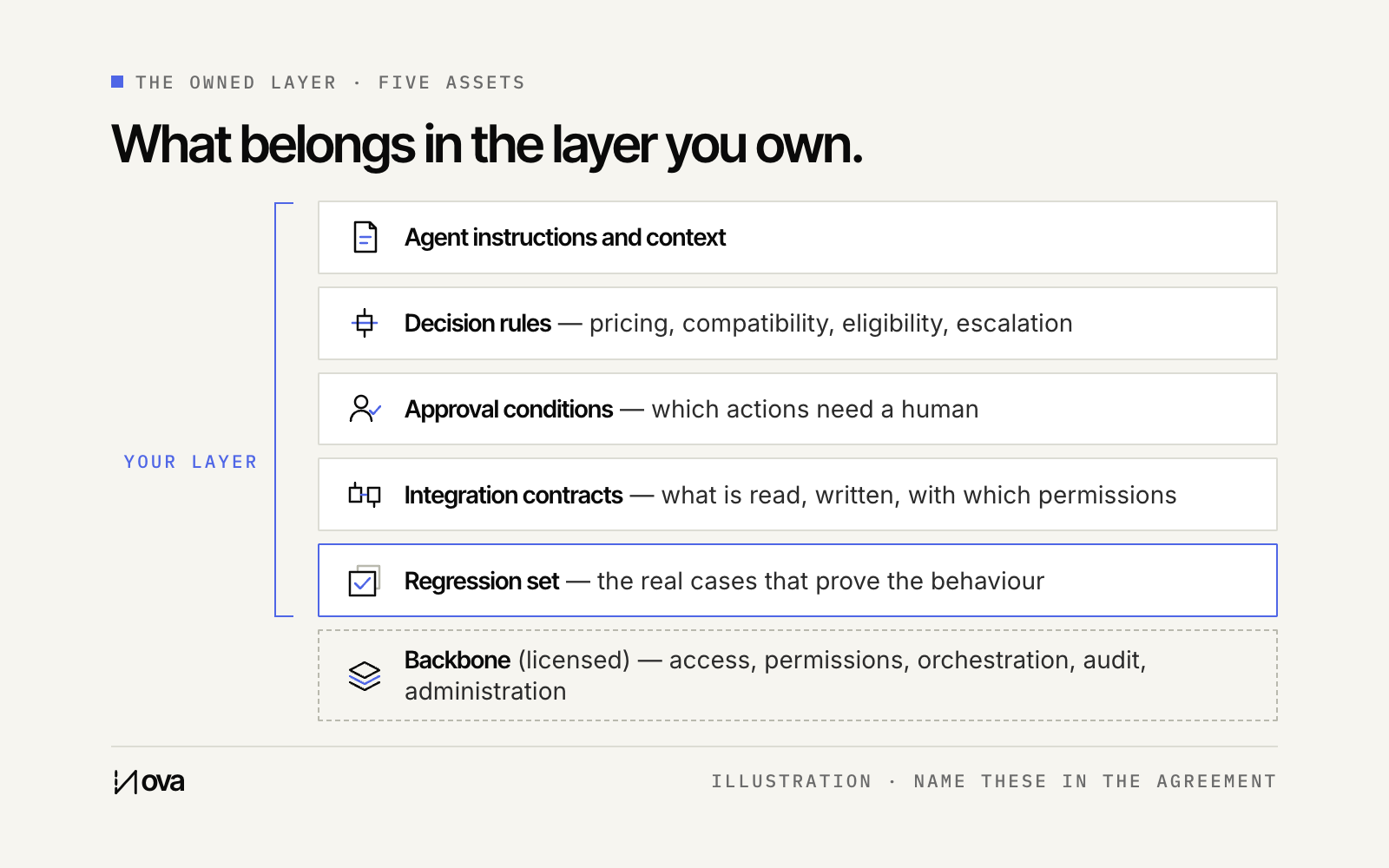
We would name those explicitly in an agreement, the same way we name code. The detail of how we split what you own from what you license sits in own your AI software: your product is yours, the backbone is licensed and maintained by us, and your environment runs in accounts in your own name — repository, hosting, database, model provider. Each customer runs in its own environment with its own data; there is no shared database across customers, and connecting a system does not mean its data has to move.
Model choice stays yours as well. Nova runs bring-your-own-key access across several model adapters, so swapping a provider is a configuration decision rather than a rewrite. The requirement most companies arrive at is not the best model — it is not being owned by any single model provider, with governance where production actually runs.
For cloud services, EU law now points in the same direction: the Data Act, applicable from 12 September 2025, sets a framework for customers to switch between providers of data-processing services. For the custom build itself, your agreement is what decides.
The layer we are still building: evaluation
One thing we will not pretend is finished. Continuous, automated evaluation of agent behaviour in production is the honest gap in nearly every agent stack today, ours included. It is the next layer we are building, and saying so is more useful than implying it exists.
Until it matures, the substitute is concrete: traces from production, a regression set of real cases that the company owns, named approval points, and human review that is actually staffed. We set out how we handle that in building evals into agentic workflows.
Why this is a decision worth making deliberately
Most companies will not replace their systems of record this decade. Almost all of them will add a workflow layer above them — through a vendor, a consultant, a platform or their own build.
The difference between those options is not the demo. It is whether, three years from now, the rules that make your company good at its work are in software you can change, move and hand to someone else. That is what our approach is built around, whether we build it with you, an implementation partner builds on the backbone, or an SME starts with an assessment that concludes you should keep and improve what you already have.
If you are weighing this for a specific system, discuss your build with us.
Own the software. Own the data. Rent the expertise.
Key takeaways
- Systems of record are splitting into two things: a data platform that holds the records and a workflow layer that runs the process across systems.
- The workflow layer is where your rules, exceptions and approval points are encoded, which makes it the software worth owning.
- Per system there are three routes — rebuild it as your own application, connect to it, or extend what the vendor ships — and most landscapes need all three.
- Connecting is not free: every integration raises the cost of leaving, so the replacement question belongs before the integration budget.
- Build the layer on a shared backbone, keep your custom code and data, and keep model choice open with your own keys.
- Evaluation is the honest gap in agentic stacks today; plan for traces, a regression set and human approval rather than assuming it is solved.
Frequently asked questions
- Does an agentic workflow layer replace our ERP?
- No. It takes over the process that currently runs inside the ERP, while the ERP keeps holding the records. Whether you later replace the system itself is a separate decision, driven by how much workflow value it still provides.
- Where should the business logic live?
- In your own layer. Agent instructions, decision rules, approval conditions and the test cases that prove the behaviour are product-specific and belong in code you own, not in a vendor's configuration screen.
- Can we build this on top of systems without decent APIs?
- Often yes, but the integration quality sets the ceiling. Where a supported interface exists, use it. Where it does not, expect a slower, more fragile path — and let that weigh in the replace-or-connect decision.
- Are we locked into one AI model provider?
- You should not be. Nova runs with bring-your-own-key model access across several adapters, so the model can change without rewriting your product. Model choice and governance are separate decisions.
- How do we know the agent still behaves after a change?
- Through traces from production, a regression set of real cases and named approval points. Continuous evaluation is the layer most agent stacks are still building, including ours; we would rather plan for it than claim it is finished.
- agentic workflows
- ERP
- system of record
- data platform
- workflow layer
- AI software ownership
- Nova Backbone