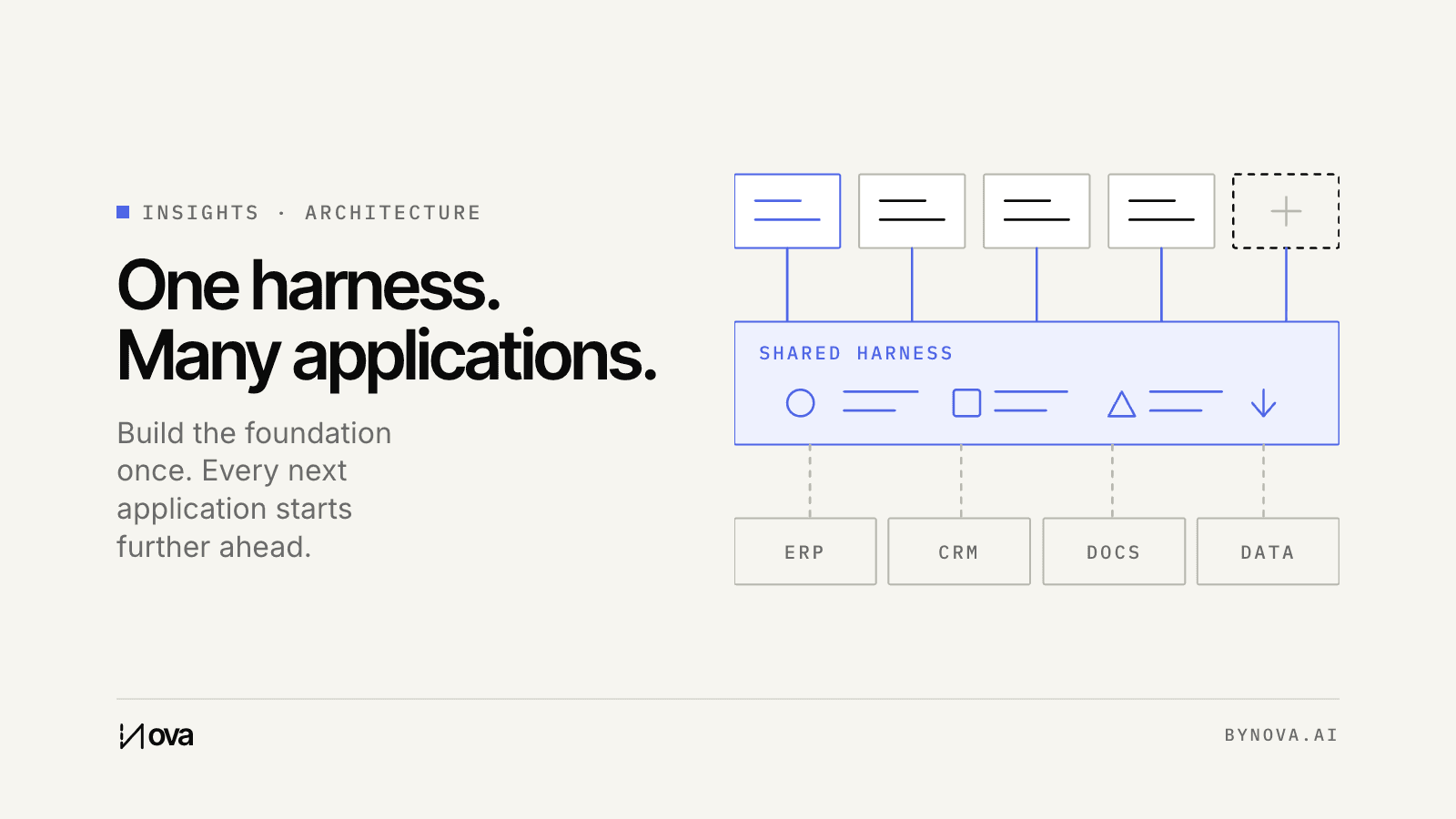
Most companies now pay for AI seats. Few run AI applications. The difference matters, because seats make individuals faster while applications change how the work itself runs, and only one of the two accumulates into something the company owns.
The step from one to the other is not a better model or another subscription. It is a shared foundation that applications can run on: an AI harness.
An AI harness is the shared foundation your AI applications run on: identity and permissions, workflow orchestration with human approval steps, an audit trail, connectors to your systems of record, and shared company context. Each new application builds on it instead of starting from zero.
A seat per person is not a system
Writing, summarising and searching with ChatGPT, Claude or Copilot is genuinely useful. But it happens next to the process, one person at a time. Nothing in the order flow, the quotation cycle or the planning changes, and nothing is measured where the work actually runs.
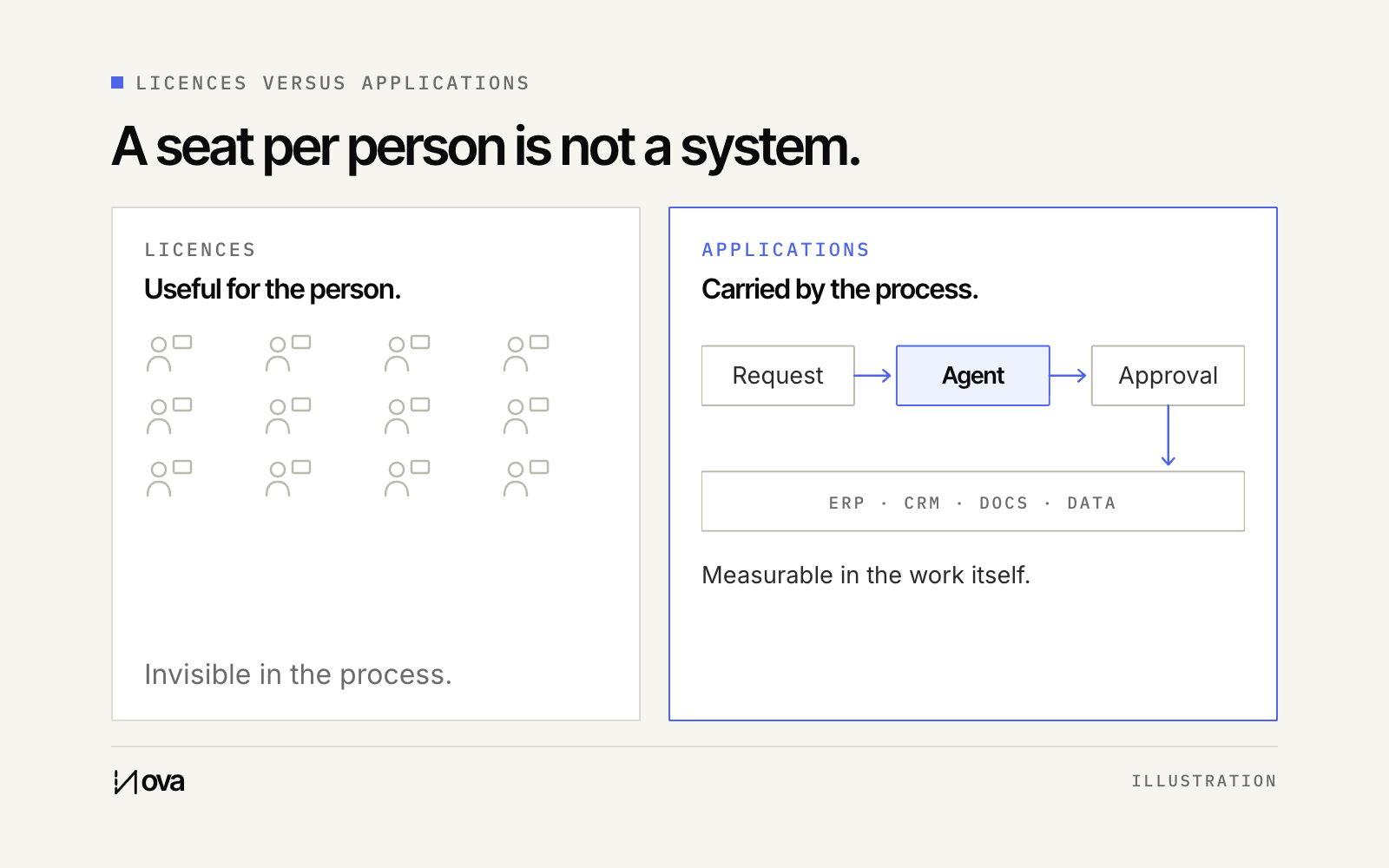
An application is different. A request comes in, an agent gathers what it needs from the connected systems, applies your rules, stops where a person must approve, and writes the result back. That is software running a process, with a before and after you can measure: handling time, error rate, throughput.
What a harness gives every application
The parts that make an application dependable are the same every time. Building them per application is how companies end up with a row of prototypes that never reach production.
| Capability | What it does | Why it should be shared |
|---|---|---|
| Access and permissions | Decides who and what may read or change which data | One rule set across applications, not one per prototype |
| Workflows with approval steps | Connects steps and stops where a person must decide | Human control designed in once, reused everywhere |
| Visibility and audit | Records what each step did and why | The evidence for compliance and for evaluation |
| Connectors | Reads from and writes to ERP, CRM, documents and data | The integration work is paid for once |
| Shared context | Makes agreed company knowledge available, within permissions | Applications get smarter together, not separately |
On Nova this is what Nova Backbone provides at its core, with Nova Memory and data connectors adding context and integrations. Your systems of record stay where they are; the harness connects to them rather than replacing them. Where the workflow logic then lives, and why that layer is worth owning, is the subject of your ERP becomes a data platform.
The second application starts further ahead
The economics of a harness show up in the second application, not the first.
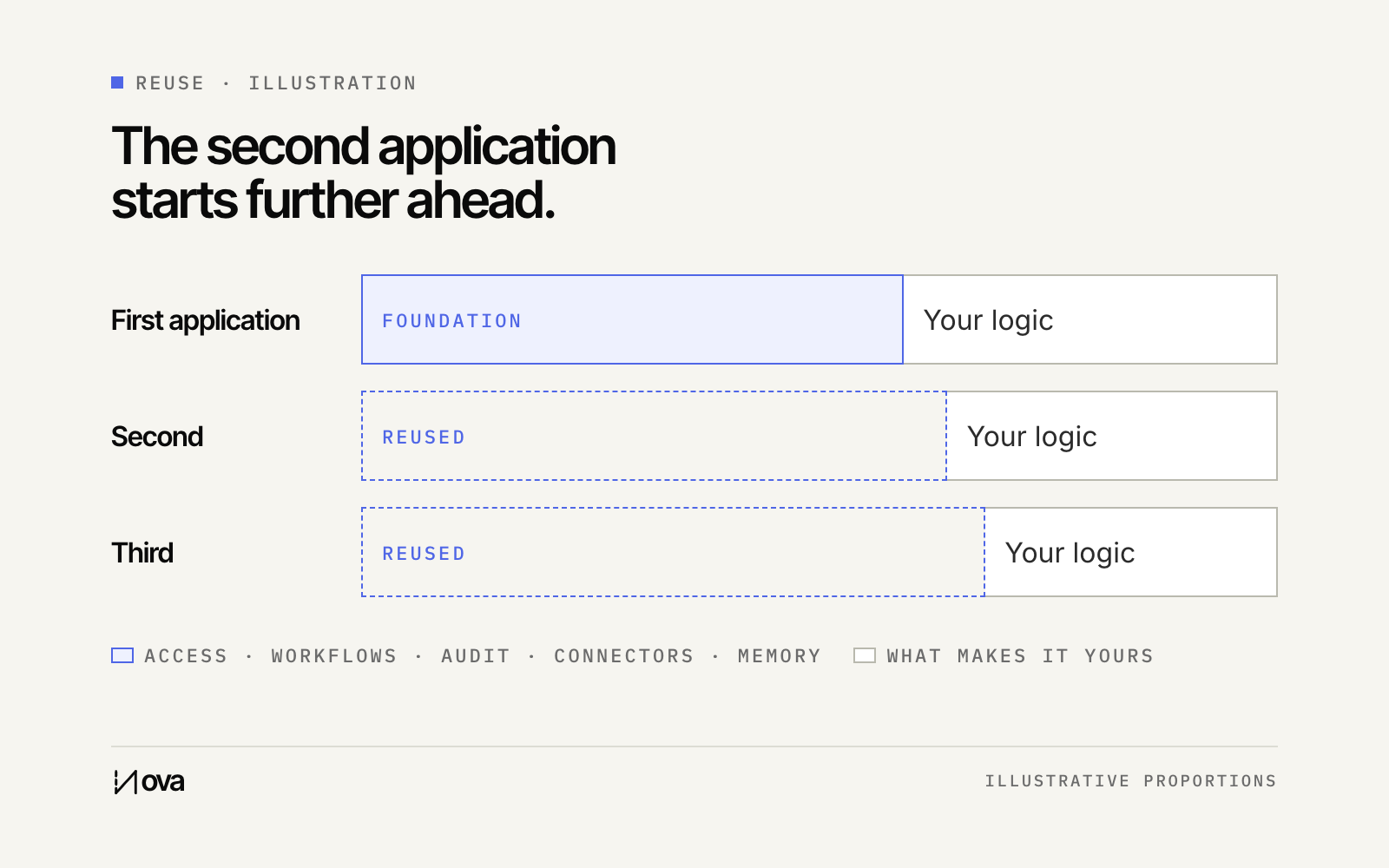
The first application pays for the foundation: access, workflows, audit, connectors, context. The second reuses all of it and only adds what makes it specific, such as its screens, its rules, its exceptions. By the third, most of the effort goes into the part that is genuinely yours. That is the opposite of how isolated tools behave, where each new one brings its own integrations, its own permissions and its own blind spots.
It is also why the order matters. Start with an application whose workflow is valuable and well understood, such as order intake, quotations or a document-heavy review, and let it carry the foundation. Our custom applications show the kind of workflows we start from.
Models change. Your harness stays.
The best model for a task today will not necessarily be the best in six months. Building the architecture around one provider turns that normal progress into a migration project.
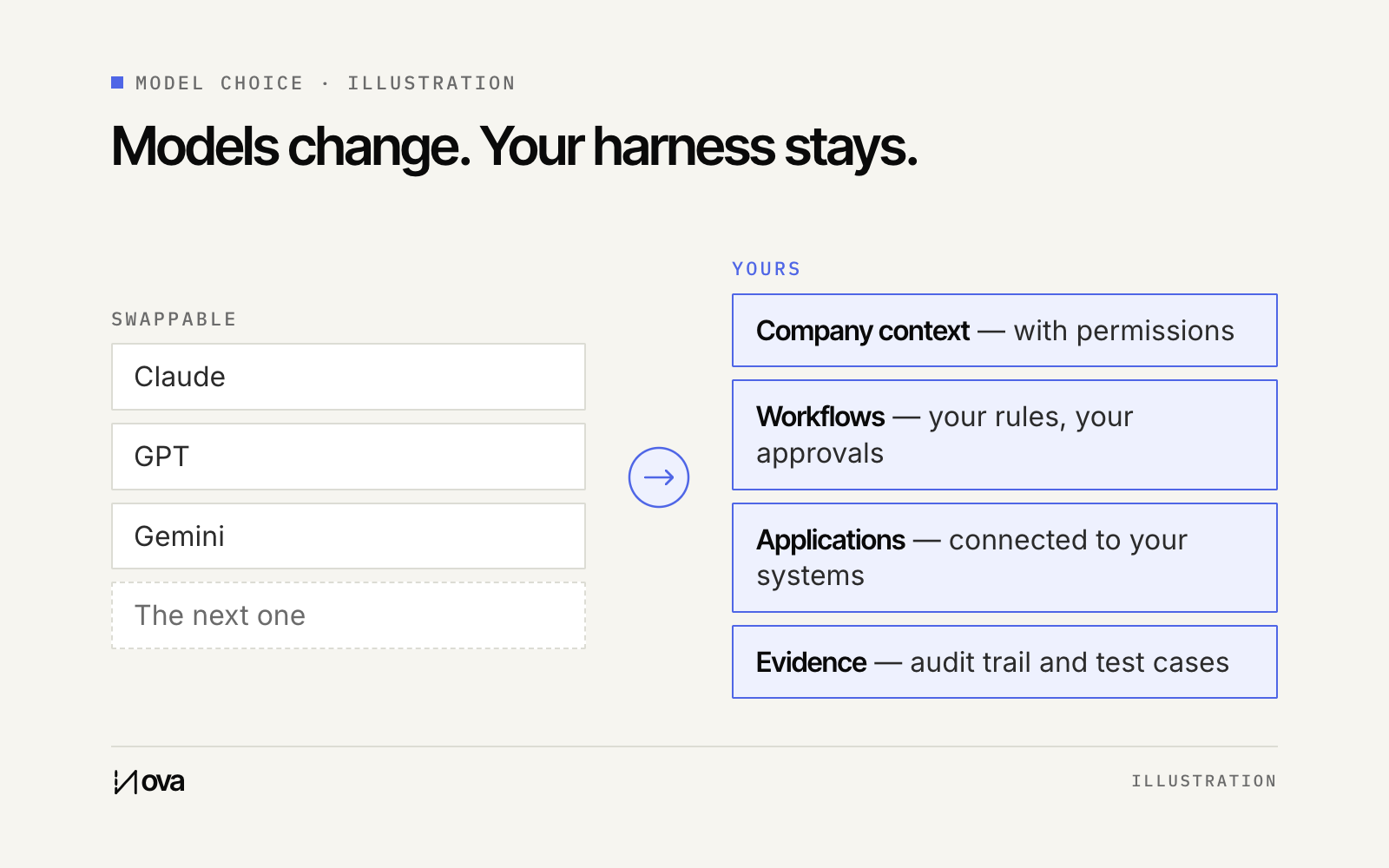
With a harness, the model is a configuration choice. What stays put is what you actually invested in: the context you gave it, the rules and approval points in your workflows, the applications connected to your systems, and the evidence of how they behave. Those belong with your custom code. How we split what you own from what you license is set out in own your AI software.
Faster teams, one place of control
The tension in most companies is familiar. Business teams want to try things now; IT has to keep access, data and architecture under control. Without a shared foundation, both lose: teams build on whatever tool is at hand, and IT inherits a landscape it cannot see.
A harness resolves that by design. Teams build applications on the same foundation, so they move faster. Access rules, data boundaries and the audit trail live in one place, so IT stays in control. Each customer runs in its own environment with its own data, and connecting a system does not mean moving its data.
When a harness is not the answer
Standard software is often the right choice. If one workflow is all you need and a product already does it well, use the product. The case for a shared foundation starts when several applications need the same context, the same connectors and the same governance. That is usually sooner than companies expect.
ScopeRight, an independent assessment and scoping practice, looks at the same shift from the buyer's side in stop buying AI tools. On our side, the question is simpler: what will you build first, so the second application is already easier?
If you have that first workflow in mind, discuss your build with us.
Key takeaways
- Licences make individuals faster; they don't accumulate into anything the company owns or can measure in a process.
- An AI harness is the shared foundation applications run on: access, workflows with approval steps, audit, connectors and memory.
- The first application pays for the foundation. Every next one reuses it and only adds the logic that makes it yours.
- Models are interchangeable behind the harness; your context, workflows, applications and evidence are not.
- One harness lets business teams build faster while access, data and architecture stay governed in one place.
Frequently asked questions
- What is an AI harness?
- The shared foundation AI applications run on: identity and permissions, workflow orchestration with human approval steps, an audit trail, connectors to systems such as ERP and CRM, and shared context. Each new application builds on it instead of starting from zero.
- How is a harness different from buying more AI licences?
- A licence gives one person access to a model. A harness lets the company run its own applications inside its processes, connected to its systems and governed in one place. Licences stay useful; they just don't add up to a system.
- Does Nova Backbone work as a harness?
- That is the role it plays: the core provides access and permissions, workflows with human oversight, visibility and audit, administration and APIs, and modules such as Nova Memory and data connectors add context. What is available for a specific project is confirmed per project.
- When is a harness not worth it?
- When you need one standard workflow that a product already solves well. The case for a shared foundation starts when several applications need the same context, connectors and governance.
- AI harness
- AI applications
- ERP and CRM
- Reuse
- Model choice