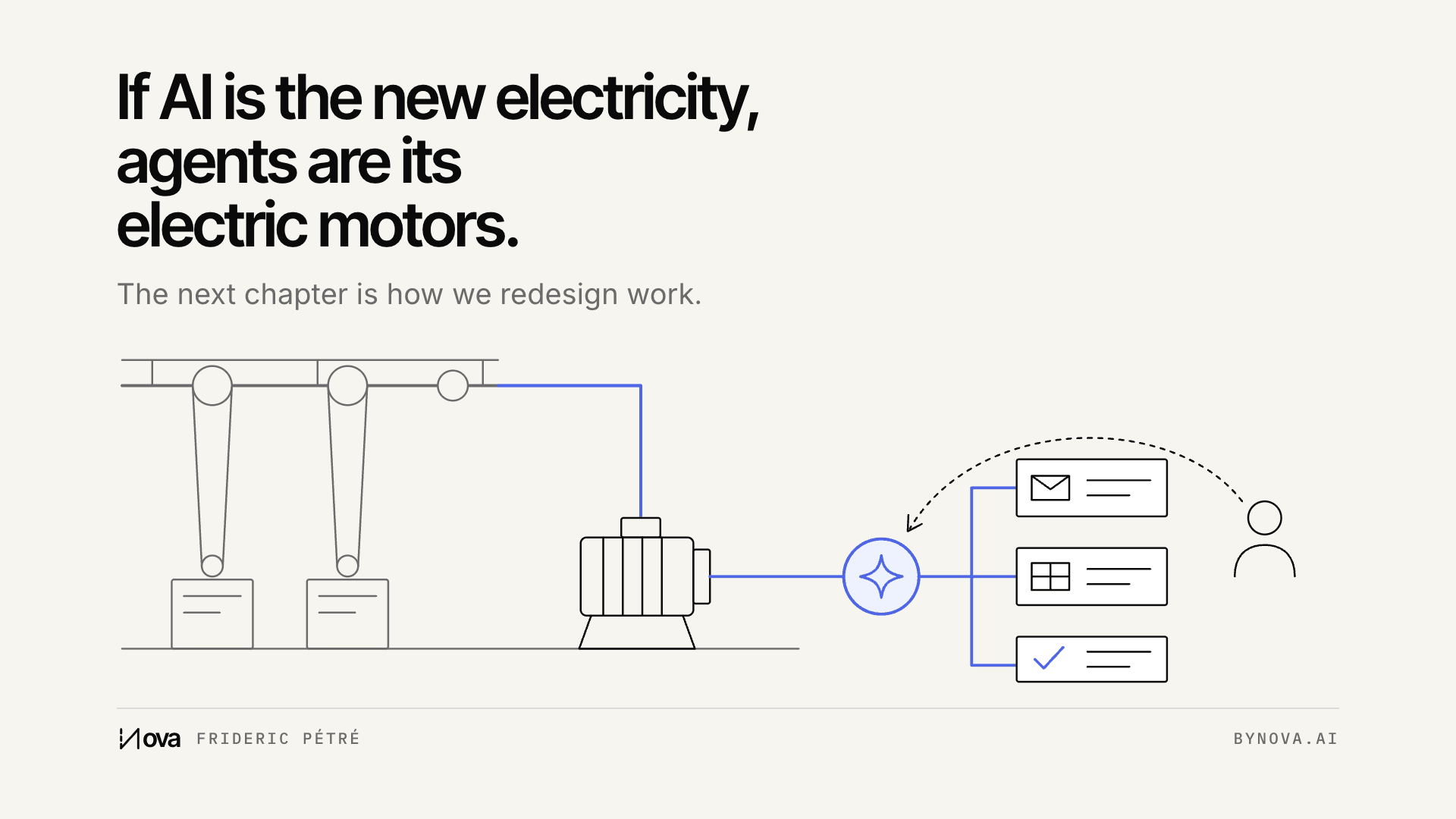
Viktor, Grok Bot and OpenAI's Dots make the shift from asking AI questions to delegating work increasingly tangible. The next opportunity is to redesign the business around that capability.
What the electric motor did for electricity
During the Second Industrial Revolution, electricity promised a different kind of factory. Getting there required much more than replacing a steam engine.
Early factories often retained their existing shafts, belts and layouts after electrification. The larger productivity gains emerged as individual electric motors made it possible to reorganise machines around the flow of production. New power required new ways of working, as the economic history of factory electrification shows.
The applications and the infrastructure developed together. An electric refrigerator in every home required reliable power, affordable components, manufacturing capacity and people who knew how to put everything together.
I believe we are seeing a similar transition with AI.
If AI is the new electricity, agents are its electric motors: the mechanisms that translate intelligence into action.
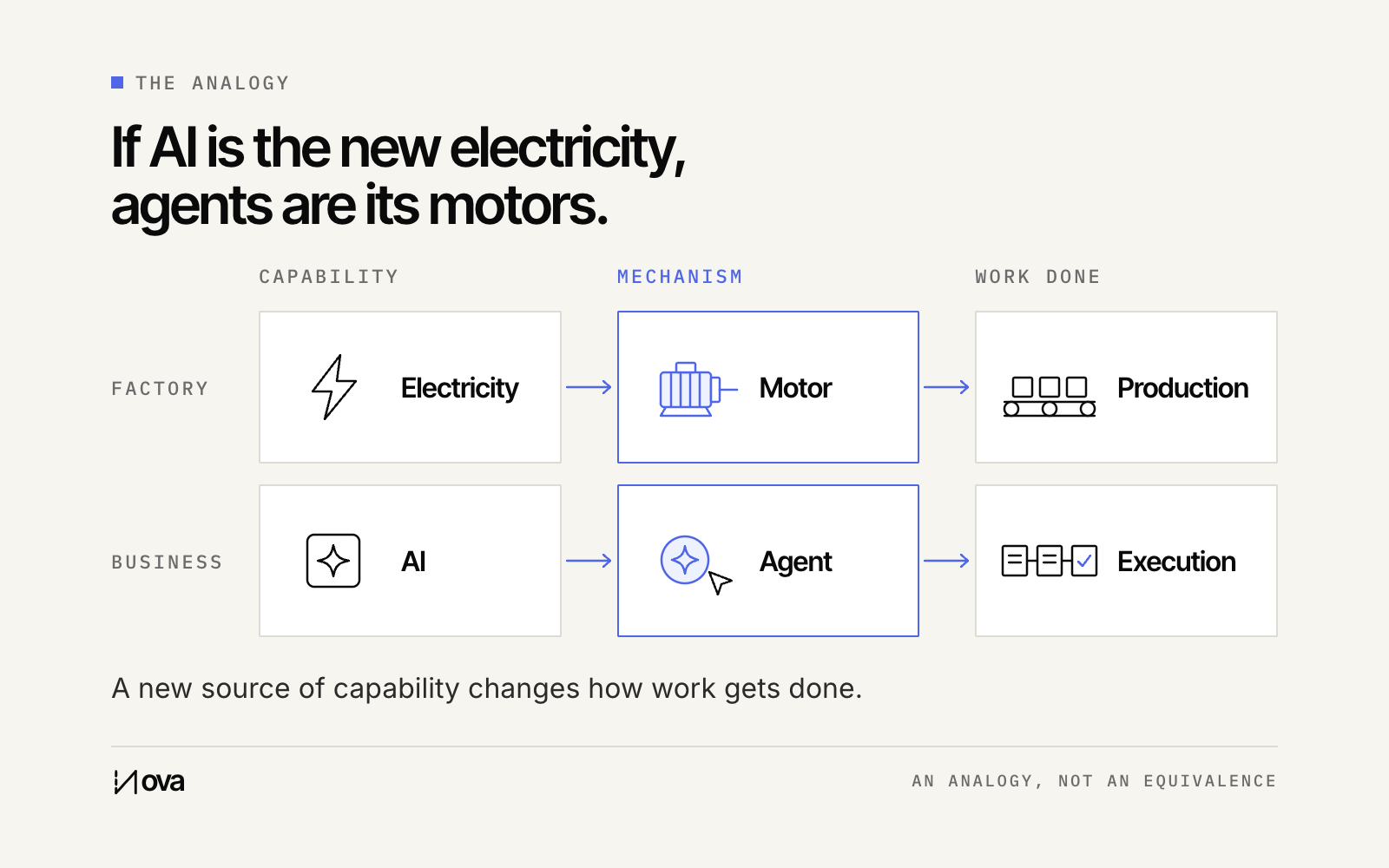
Today, people still connect much of the machinery of business manually. We read an email, look up an account, check a spreadsheet, update a CRM and ask a colleague what should happen next. Agents are beginning to carry out those sequences through the same tools and the integrations behind them.
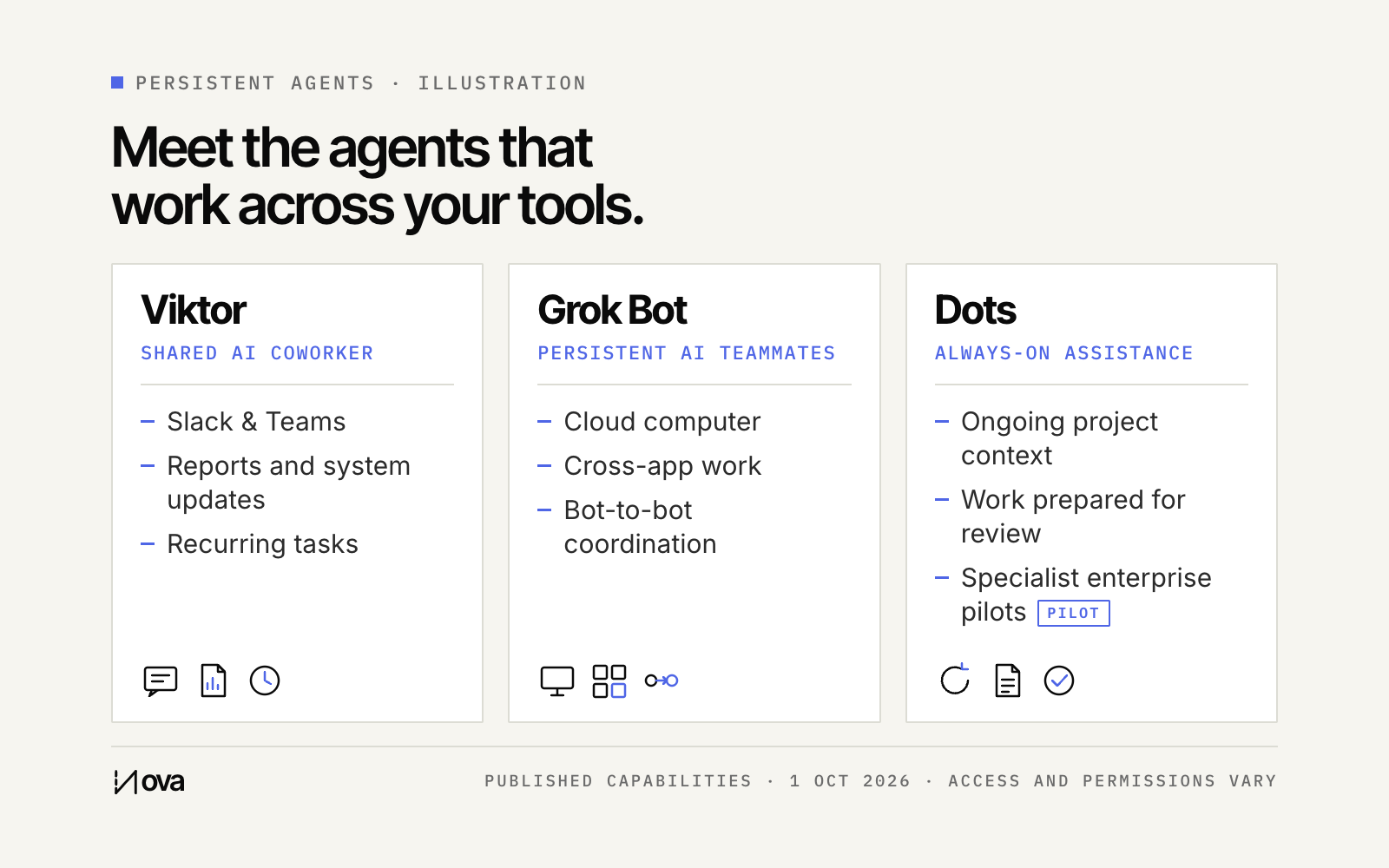
Three products help explain what this means in practice.
What do Viktor, Grok Bot and Dots actually do?
Viktor: a shared coworker inside the team's workspace
Viktor works inside Slack and Microsoft Teams and connects to business applications. Its product spans research, data analysis, reports, system updates and scheduled tasks. The team can delegate work through a familiar conversation rather than setting up another separate workspace.
An illustrative brief might be: "Review this week's pipeline, identify stalled opportunities and prepare the report for Monday." The useful outcome is the completed analysis and deliverable, with appropriate access and review.
Viktor already positions itself as a shared team coworker. That matters: this category has progressed beyond assistance for an isolated individual.
Grok Bot: persistent agents that can coordinate
Grok Bot provides named agents with continuing context and access to a cloud computer. They can work through connected services and browser interfaces, including some tools without dedicated integrations. Multiple Bots can exchange information and pass tasks between them.
Its launch examples include account research, CRM updates, draft outreach and operational work. A research Bot can prepare the information another Bot needs for a follow-up, with people approving the relevant actions.
The interesting development is continuity: work can move between tasks and agents without a person repeatedly transferring the context.
Dots: ongoing assistance across projects
OpenAI's Dots, announced on 29 September 2026, are persistent agents that can work across connected applications and continue progressing projects between conversations. Examples include adapting launch materials, developing fixes for review and maintaining proposals as requirements evolve.
The launch starts with a primary dot. Specialist dots for organisational responsibilities are being tested through enterprise pilots; broader teams of dots are part of the stated direction. Availability depends on plan, region and rollout.
Here too, the change is continuity: an assistant that keeps track of an evolving objective and prepares the next useful piece of work.
A natural extension of human capability
These products overlap. All three bring aspects of memory, tools and execution into a conversational experience. Their packaging, access models and deployment options differ.
What they share is a shift in our relationship with software. We can increasingly specify a desired outcome and delegate some of the steps needed to achieve it.
To me, that is a natural extension of human capability. Technology has extended our physical reach, memory and ability to communicate. AI extends our capacity to analyse, create and coordinate. People continue to set priorities, make commitments and judge whether the result is good enough.
The last three years have built towards this moment. In 2023, conversational models such as GPT-4 made writing, analysis and coding assistance widely tangible. In 2024, multimodal interaction, as in GPT-4o, broadened the interface. During 2025, reasoning and open-weight models such as DeepSeek-R1 and Qwen3 expanded the options for builders. The recent wave of persistent agents brings those capabilities into ongoing work.
This is a progression in emphasis, with considerable overlap between stages.
Why do the economics make more applications possible?
Stanford's AI Index documented a reduction from $20 to $0.07 per million tokens for models reaching GPT-3.5-level MMLU performance between November 2022 and October 2024: more than a 280-fold decline at that benchmark level.
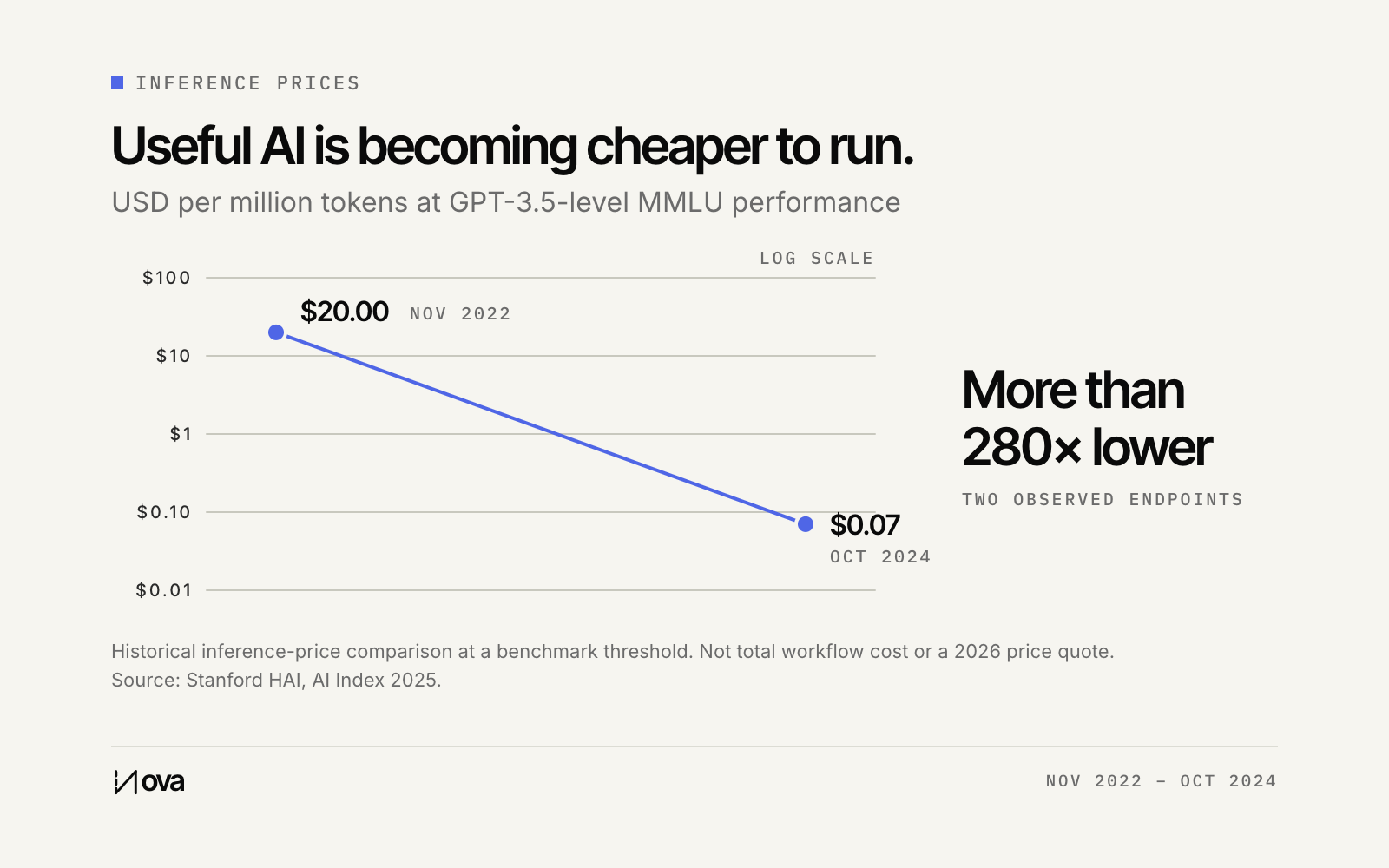
That does not mean every workflow is 280 times cheaper. Integration, verification, hosting and operations still matter. But falling inference costs and a broader choice of models change which applications are worth building.
In the electricity analogy, more businesses can afford to install more motors.
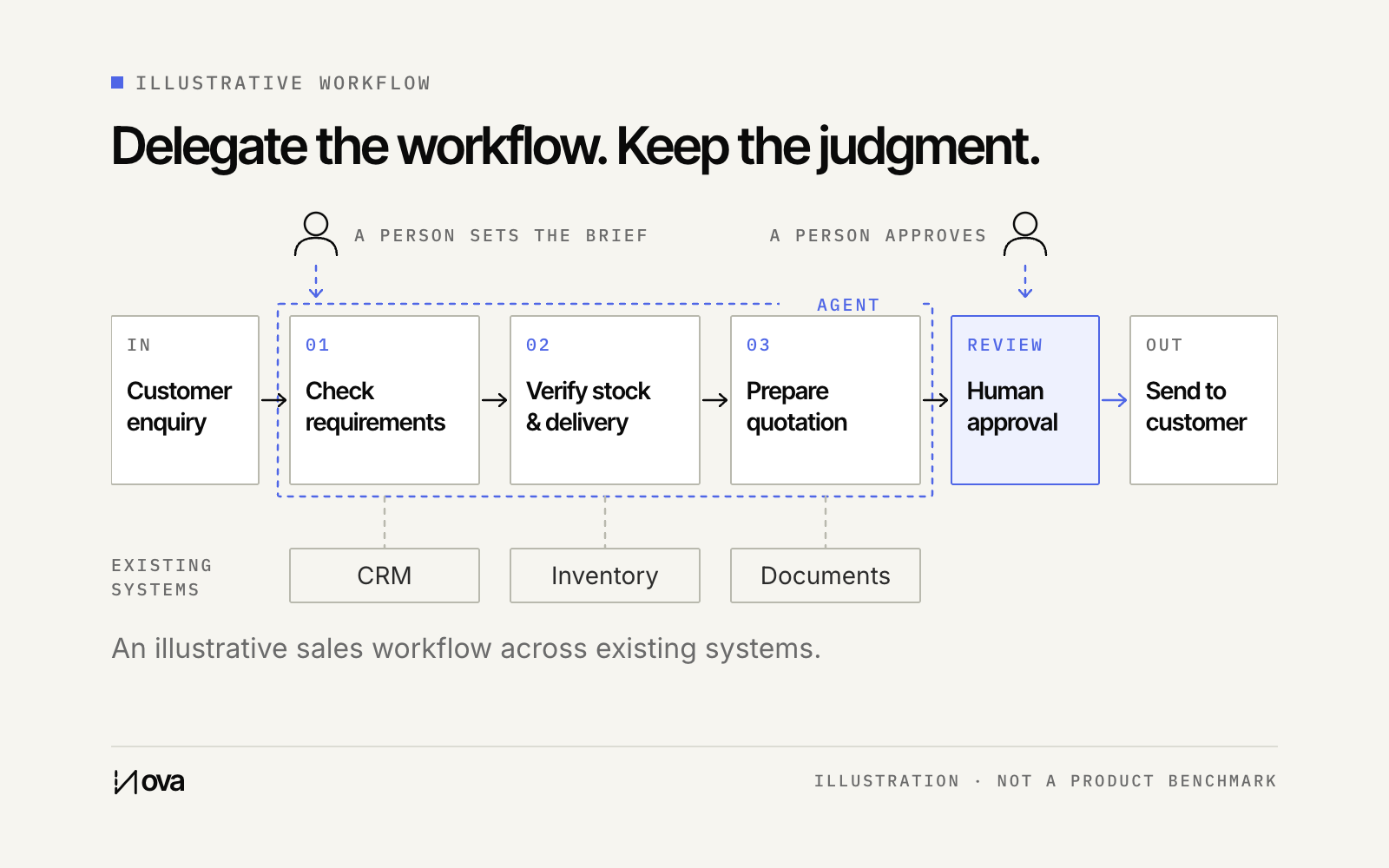
Consider a distributor that needs to interpret enquiries, identify compatible parts and prepare quotations. Or a manufacturer that must translate customer briefs into validated production instructions. Or a service firm that wants its expertise embedded in a dedicated application.
These are illustrative opportunities to connect complete workflows, of the kind we describe as custom applications built around the way a business works. The value comes from faster throughput, fewer errors and less coordination overhead.
From adopting agents to building your own operating environment
The early electric factory offers a useful lesson. Replacing the power source improved the existing machinery. Redesigning the factory opened a larger opportunity.
Agents can help us operate today's software. They also invite us to reconsider the software and processes we need tomorrow.
That is why we deliberately chose to invest in the infrastructure layer this year.
ScopeRight, the independent assessment and scoping practice I founded, helps businesses assess their current applications, identify valuable workflows and decide where to buy, build or partner. Its companion piece looks at what persistent agents mean for that decision.
With Nova, we are building a reusable backbone for company-specific software and agents: shared context, memory, integrations, orchestration, permissions and human approval. Nova Backbone carries the parts that are the same every time; Nova Memory and Nova Companion add context and an assistant inside the product.
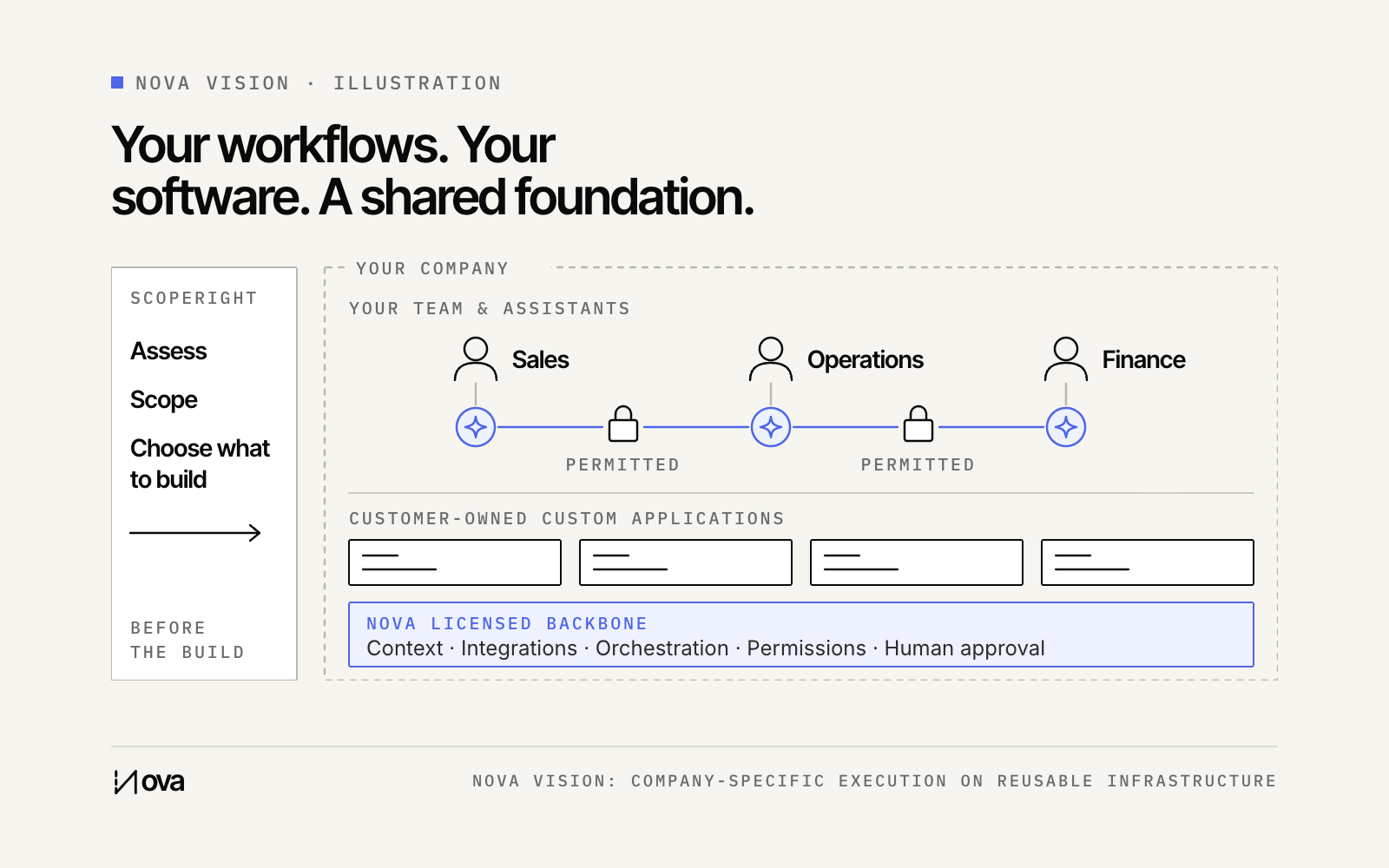
Our vision is that each team member can work with an assistant, while assistants coordinate across the business within the right boundaries. Sales can prepare a proposal using information checked with operations and finance. People can focus on the customer and the decisions that need their judgment. This is a direction we are building towards, not a description of everything that is available today.
Viktor, Grok Bot and Dots already demonstrate elements of team execution. Nova's focus is on making this approach part of a company's own operating environment, including the custom applications and business logic that make it distinctive.
We provide the picks and shovels: a reusable foundation intended to make custom software more affordable, with transparent consumption and delivery focused on measurable outcomes. Customers own the custom applications created for them; Nova supplies the licensed backbone and expertise. What that split means in practice is set out in what to own when a partner builds your AI software.
Own the software. Own the data. Rent the expertise.
Dependable results are a responsibility
I welcome the optimism around what becomes possible. Turning it into dependable results is the responsibility of builders, service providers and the businesses deploying these systems. Permissions, testing, monitoring and human oversight belong in the foundations, which is why we treat evals for agentic workflows as part of the product and not as a one-off test.
We are learning how to design the new factory. Many of its most valuable applications are still ahead of us.
Exciting times ahead. If you have a workflow in mind, discuss your build with us.
Source notes, checked 1 October 2026. Product descriptions reflect published vendor capabilities, not an independent performance test. Examples identified as illustrative are proposed workflows, not customer results.
Key takeaways
- Agents are to AI what electric motors were to electricity: the mechanism that turns a general capability into work.
- Viktor, Grok Bot and Dots show that software can now take a brief, keep context and return work for review.
- Inference at GPT-3.5 level became more than 280 times cheaper between November 2022 and October 2024, which changes which applications are worth building.
- Electrified factories gained most when they reorganised production around individual motors; businesses gain most when they redesign workflows around agents.
- Nova's focus is a company's own operating environment: custom applications the customer owns on a reusable, licensed backbone.
Frequently asked questions
- What does it mean that agents are the electric motors of AI?
- Electricity only changed factories once electric motors turned it into motion at each machine. In the same way, AI models provide capability and agents turn that capability into completed work by operating tools, following a brief and returning a result for review.
- What do Viktor, Grok Bot and Dots have in common?
- All three bring memory, tools and execution into a conversational experience, so a person can specify an outcome and delegate some of the steps. They differ in packaging, access model and deployment options, and their capabilities depend on plan, permissions and rollout.
- Are AI workflows 280 times cheaper than in 2022?
- No. Stanford's AI Index reports that the price of inference at GPT-3.5-level MMLU performance fell from 20 dollars to 7 cents per million tokens between November 2022 and October 2024. Integration, verification, hosting and operations still cost money, so a complete workflow has not become 280 times cheaper.
- How is Nova different from Viktor, Grok Bot or Dots?
- Those products are agents a team can adopt. Nova is a reusable backbone and a senior team for building a company's own software and agents: custom applications and business logic the customer owns, running on a licensed foundation with permissions and human approval. Assistants that coordinate across a business are Nova's stated vision, not a description of released functionality.
- AI agents
- Persistent agents
- Agentic software
- Operating environment
- Nova Backbone